The case for Direct Video Calling in today's contact centers
If a customer called your contact center and had to go through a third party just to speak with your team, you'd see it as a customer experience problem. Take a closer look and it’s also a friction and efficiency problem that affects your bottom line. There's also a security concern. Routing sensitive customer data through a third party creates fraud risk, especially around PCI and CPNI compliance.
That's exactly what millions of Deaf customers deal with every time they contact a business or company. Most companies don't realize it's happening. And most don't realize there's already a better option: direct access, the same kind that every other caller who is not Deaf already has.
What Is Video Relay Service, and Why Does It Fall Short?
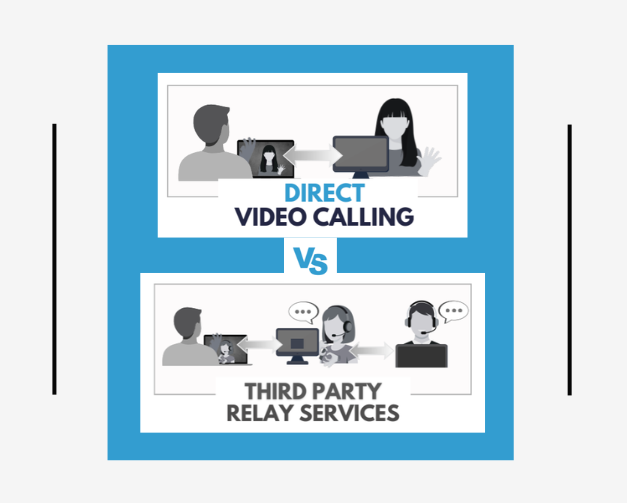
When a Deaf person calls a contact center, they're typically routed through a Video Relay Service (VRS), a three-way call that runs through a third-party interpreter. The customer sees and signs to the interpreter on video. The interpreter speaks to your customer service agent. Your agent speaks back. The interpreter signs back to the customer on video.
Every step adds time, costs money, and creates room for miscommunication and disconnect between your team and your customers.
It's a slow and indirect communication method. Outdated. And for the more than 11 million Deaf and Hard of Hearing people in the United States, it's the default. But that can easily be fixed.
What Is Direct Video Calling?
Direct Video Calling (DVC) removes the relay entirely and makes it a two-way call, just like every other customer call. A Deaf customer makes a video call directly to a contact center agent who is fluent in American Sign Language (ASL). It’s similar to when two people connect on FaceTime. No third party. No interpreter in the middle. Just two people communicating directly in the same language.
The Federal Communications Commission (FCC) recognizes DVC as an accessibility standard for Deaf and Hard of Hearing customer communication, because it's a point-to-point connection that puts the customer first.
CSD Access has been building and expanding on this idea for more than a decade, partnering with organizations including Comcast, Xfinity, Cox, Google, Walmart, the 988 Suicide & Crisis Lifeline, ABLEtoday, and many more.
What Does Direct Video Calling Do for Your Business?
Companies using DVC have reported measurable results:
Deaf and Hard of Hearing customers also represent an estimated $9 billion in discretionary income in the U.S. Research shows they are especially loyal to companies that serve them in their language. That's not just an accessibility story or a feel-good story. It's the truth of a market trend from this untapped community.
Why Does This Matter Now?
Deaf customers have made it clear: accessibility isn't optional; it's expected. When the experience doesn't match that expectation, trust breaks down. DVC closes that gap by embracing the authenticity of natural two-way conversations. The same way representation matters to many in media, it matters in how your business shows up for Deaf customers every day.
A Question Worth Asking
"Today, most Deaf people require a three-way relay call to reach customer service," said Greg Pollock, Division President of CSD Access. "DVC removes this unnecessary barrier, not only providing ideal communication, but a superior customer service experience of shared language and culture with indisputable business results."
Your contact center can do better for Deaf customers. The question is whether you know where to start.
Ready to serve every customer directly?
See how CSD Access helps organizations serve Deaf and Hard of Hearing customers directly, in their language.